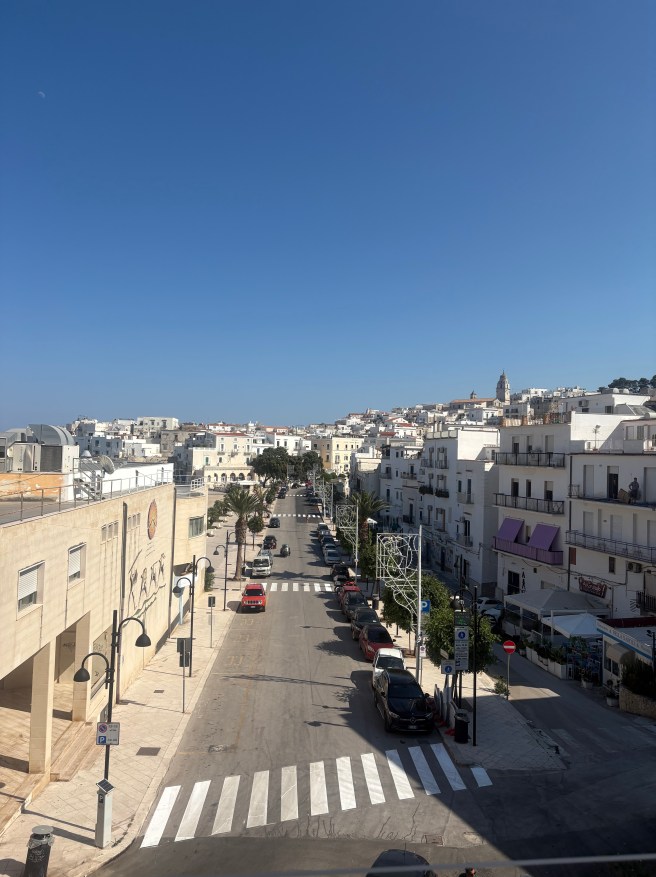
Italy never ceases to amaze me. I rolled into Vieste expecting a laid‑back little beach town , something like an Italian Folly Beach or Sullivan’s Island from back home in Charleston. At first glance, it even looked the part. But I was mistaken.
My drive in had followed the winding mountain coastal highway, a white‑knuckle ribbon of road clinging to cliffs and curves. Larger beach resorts bookended the town, and as always in Italy, finding the rental was its own scavenger hunt. Road signs, unit numbers, and basic casa signage remain optional concepts here. Still, I eventually located the address and waited for the owner to hand off the keys.
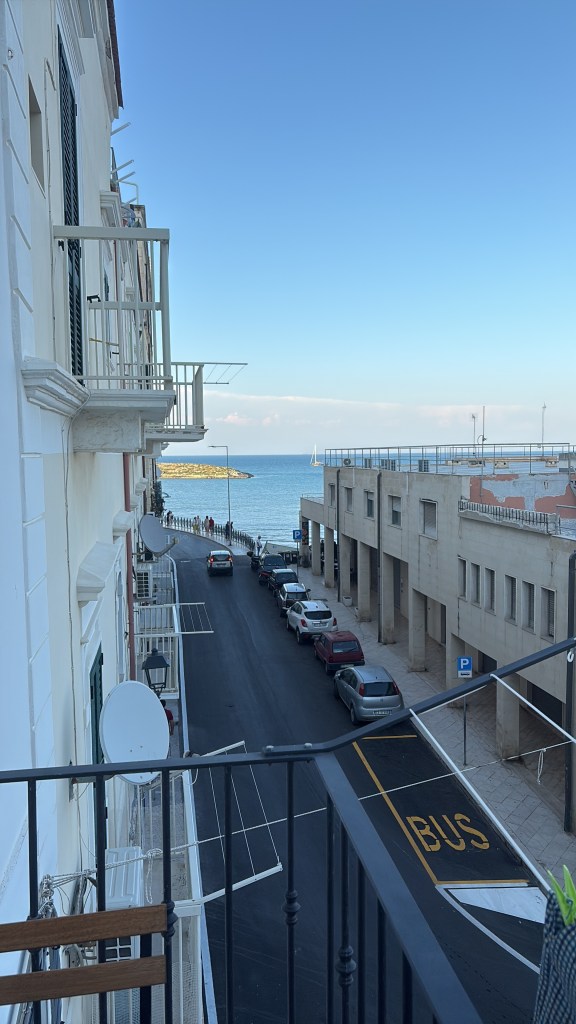
The two‑bedroom efficiency was clean, bright, and opened directly onto the main strip running through town. The beach was only steps from my door, and a small waterfront piazza with benches sat just across the way. Driving in, I’d passed the usual beach‑town suspects, sidewalk shops, restaurants and souvenir stands but I was ready for the real introduction: a swim.
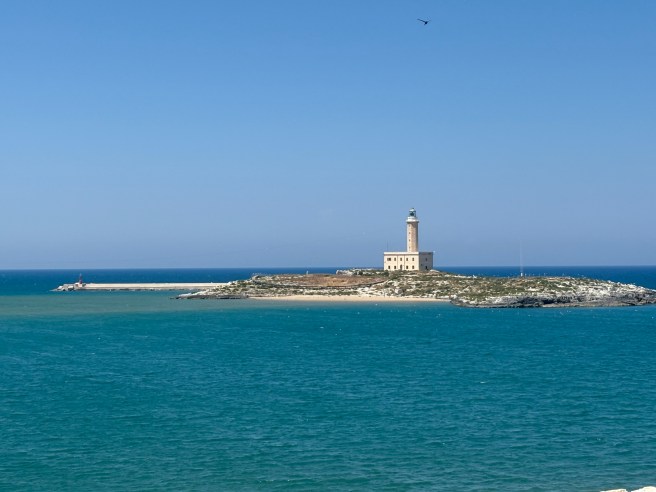
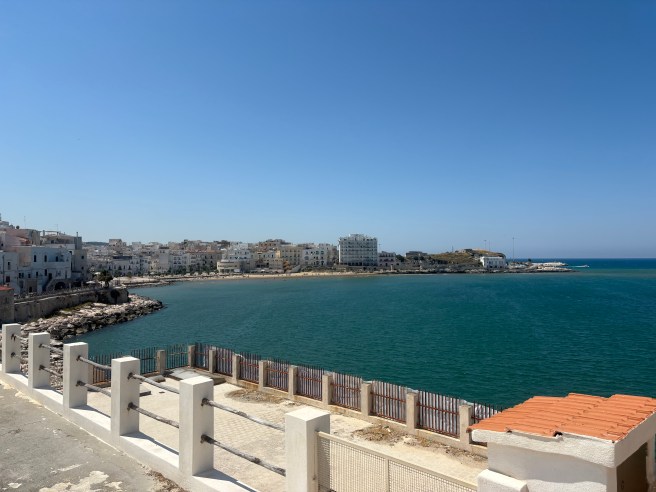
The beachfront was compact, framed by a marina and lighthouse on one side and a rocky curve of coastline crowned by a church on the point. The shallow, bay‑like cove created a long, gentle basin with a sandbar stretching almost all the way to the lighthouse, which stood alone on its own little island. Beyond the ripples, the water deepened into a clear, impossible blue.
Swim complete, I returned to my flat and immediately hit a snag. The secondary door to the vestibule was locked. The same door the owner had specifically told me not to lock. The same door he did not have a key for.
Panic set in. No phone, no cash, no ID. Just the main door key and the key to my flat, both now uselessly on the wrong side of a stubborn, ancient door.
I tried every key in every lock. Nothing. I shoved, rattled, pleaded. Nothing. I stepped back out to the street, then returned again, when I finally heard a loud noise from inside, a hair dryer, blasting like a jet engine. I knocked, banged, shook the door until the noise stopped and someone emerged from the neighboring flat.
I explained I was staying in the ultra habitatione, but she retreated without a word. A moment later I heard her on the phone repeating “sì, sì, sì,” and then the lock clicked open. She darted back inside. I guess the owner forgot to tell her not to lock the door. I taped over the lock to spare future guests the same fate. I never saw her again, but that hair dryer ran for hours — likely doubling as a clothes dryer, since actual dryers are rare in southern Italy.
Crisis resolved, I showered and headed out to explore.
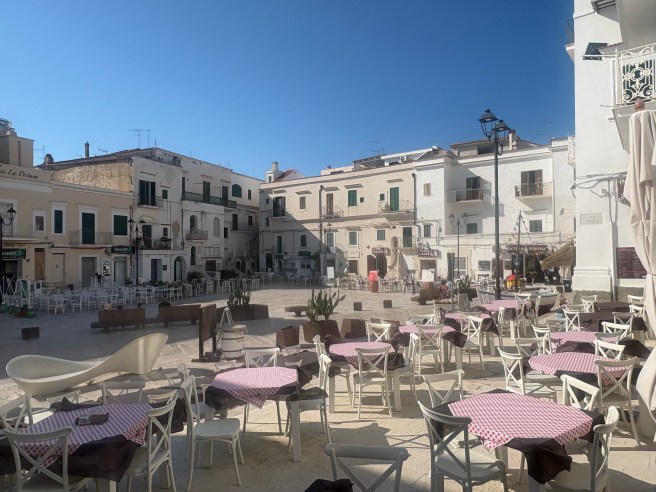
Opposite the beachfront piazza sat a row of restaurants set back from the road, with more shops, eateries, and electronics stores curving right toward another central piazza. To the left, a wide open space — not quite a piazza, so I’ll spare the repetition — held even more restaurant seating. A narrow road from there led down to the church at the tip of the peninsula, lined with shops and trattorias.
Charming enough, I thought. Small, manageable, lived‑in. But Italy always has a twist.
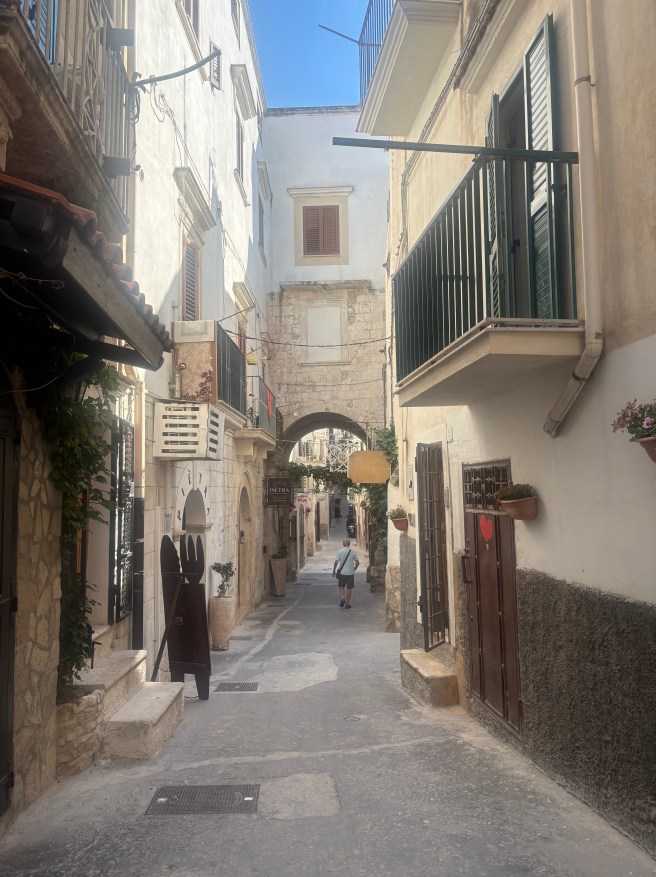
Just above that open dining area, tucked into a hill, was an entire neighborhood accessible only by a couple of narrow alleyways. And inside that maze? Even more restaurants, patios, souvenir shops, butchers, bakeries, olive oil stores, dried pasta displays, artisan workshops, clothing boutiques, and gelaterie. Vieste may be small, but it clearly feeds the crowds pouring in from the neighboring beach towns.
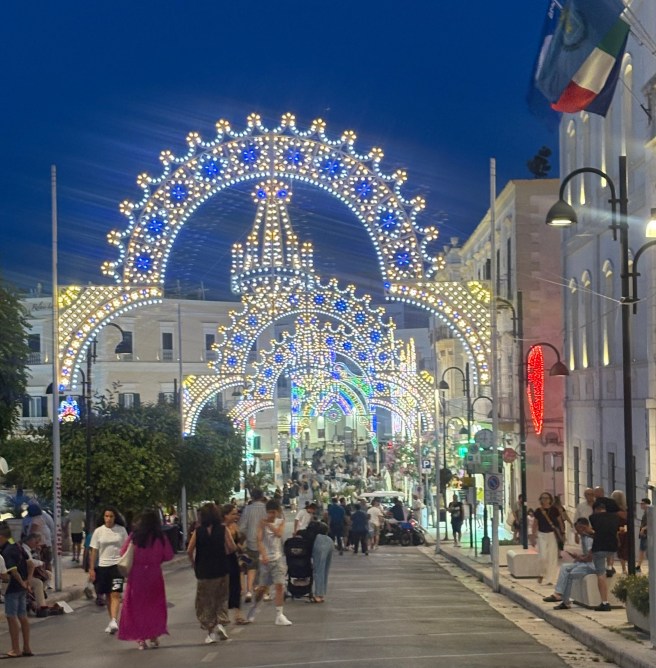
And pour in they do. As soon as the sun sets, police barricade the main road and hundreds of people descend for dinner, drinks, gelato, and entertainment. During my stay, the local youth program rotated nightly performances , elementary and high‑school bands playing in different piazzas along the waterfront.
Seafood dominated the menus again, and pizza was everywhere. But the surprise? Crêpes. Crêpe carts, crêpe shops, even a crêpe kiosk in the middle of the main piazza. I learned that French tourism boomed here in the 1980s, and locals adapted by offering crêpes. They were cheap to make, wildly profitable, and beloved by kids. The tradition stuck.
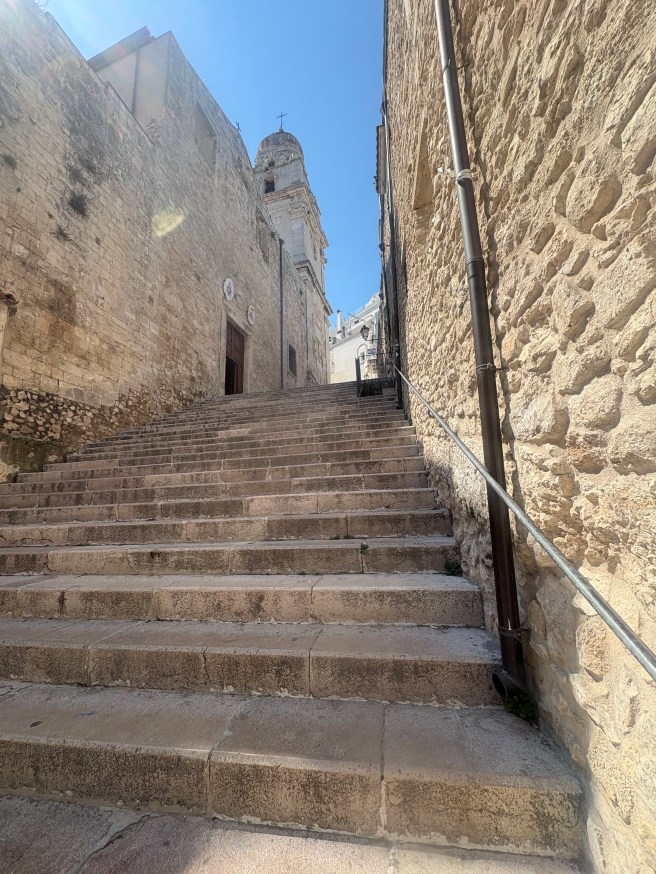
As I sit now at the cocktail bar in the center of the piazza, I’m amazed at the Monday‑night crowd. But like any beach town anywhere, if you build it, they will come. The more I walk, the more the town unfolds, alleys, arches, staircases, restaurants, shops, and architecture that glows under the streetlights.
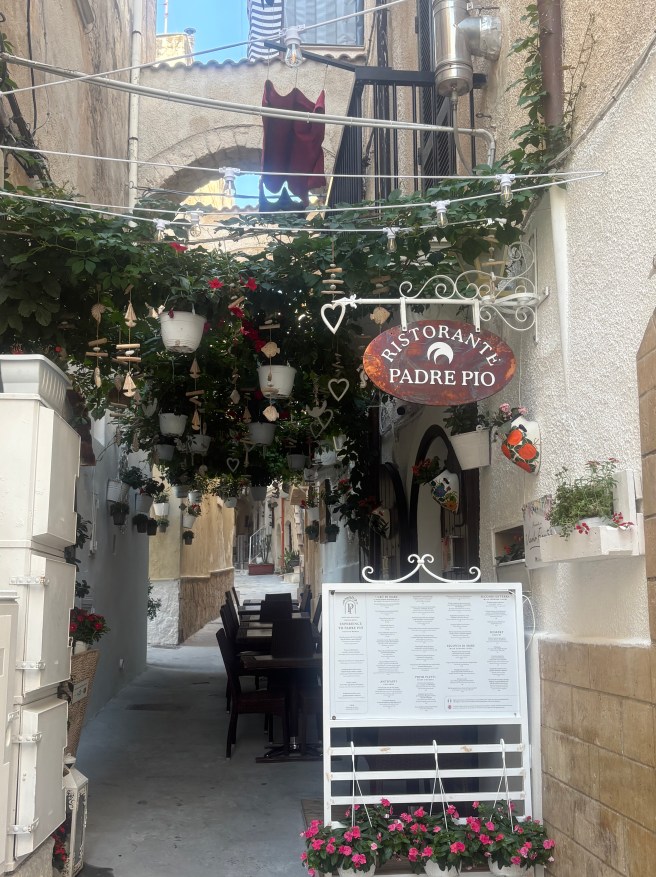
My first meal was an easy choice: Ristorante Padre Pio, tucked in an alley draped with vines, hanging plants, and maritime wind chimes. The menu tempted me with cod‑stuffed tortelloni, braised beef cheek, and tagliatelle with monkfish and veal stock. I chose the monkfish, the poor man’s lobster and it was perfect. I paired it with a glass of house white, which I’ve learned is always the smartest choice: local, fresh, and better than most bottles. Dessert was a chocolate, sour cherry, and raspberry creation whose name began with the Italian word for “sensational.” And yes it was.
By 11:30, the streets were still alive with families, tourists, teenagers, toddlers, even infants being wheeled around in strollers. Vieste has no curfew, only rhythm.
I ended the night sitting in the piazza in front of my flat, finishing my notes on Matera while the memory was still fresh in my mind. The next few days would be a return to the coast. A return to restful sun soaked days on the beach with random walks throughout town.